
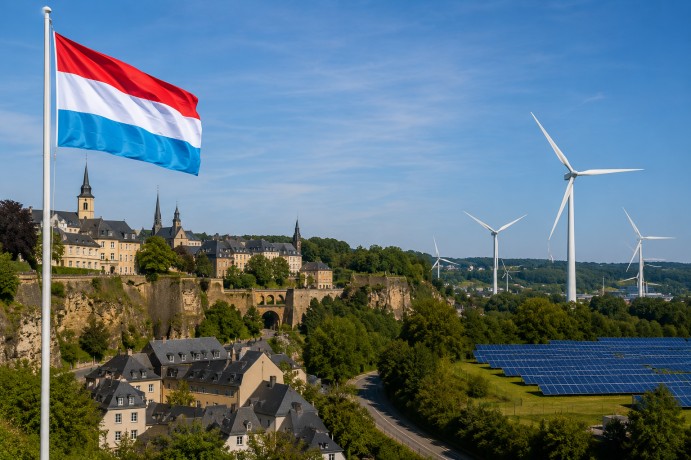
In a recent assessment by Eurostat, Luxembourg was identified as one of the European Union’s lowest-ranking countries for renewable electricity consumption in 2025. Despite a general increase in renewable energy use across the EU, Luxembourg’s performance was notably lacking. The nation’s reliance on renewable sources accounted for just 20.2% of its gross final energy consumption, marking it as one of the bloc’s least successful in this area.
When focusing specifically on electricity consumption, Luxembourg reported that only 23.3% of its electricity came from renewable sources. This figure places it just ahead of Czechia and Malta, the only two EU countries with a lower percentage of renewable electricity usage. The EU as a whole saw renewable energy contribute to 26.2% of its gross final energy consumption in 2025, a significant rise from 9.6% in 2004, with an ambitious target set to increase this share to 42.5% by 2030.
Among the EU member states, Sweden emerged as the leader, with an impressive 65.4% of its overall energy consumption sourced from renewables. Following closely were Finland and Denmark, both showcasing strong commitments to renewable energy. Austria, however, set the benchmark for renewable electricity consumption, generating over 90% of its electricity from renewable sources, a remarkable achievement within the EU.
This data highlights the varied progress and commitment levels across the European Union regarding renewable energy adoption. While some countries have made significant strides, others, like Luxembourg, still face challenges in increasing their renewable energy consumption to meet the EU’s future targets. The disparity underscores the need for continued efforts and policy adjustments to ensure that all member states can contribute effectively to the EU’s environmental goals.